
National Radio Day: The Signal Was Jammed. People Still Listened.
From a shortwave broadcast heard behind the Iron Curtain to today’s satellite and digital outreach, GCMM’s story is a reminder that technology can become a powerful instrument for the Great Commission.
On National Radio Day, we remember something that reaches much deeper into the history of Great Commission Media Ministries than a microphone or a transmitter.
Before Laura Haukka became a broadcaster, she was a listener.
As a young girl growing up in the Soviet Union, Laura lived in a country where Christian teaching was tightly restricted and outside broadcasts were deliberately blocked.
By 1959, the Soviet Union had more than 100 million shortwave radios—but it also operated thousands of jamming stations designed to keep foreign broadcasts from reaching Soviet listeners.
Still, some signals got through.
One evening, a Finnish-speaking Christian woman named Aino discovered a programme being transmitted from Radio Tangier in North Africa. She hurried to Laura’s family and urged them to listen.
Late that night, the family gathered around a large brown radio. They turned the dial until the distant signal came through.
Across thousands of kilometres, a preacher began explaining the love of God and His plan of salvation.
Laura listened.
She could not see the person speaking. The broadcaster had no idea who was sitting beside a radio somewhere inside the Soviet Union. But the message crossed borders that missionaries could not freely cross.
Years later, knowing firsthand what media could do, Laura became part of the broadcast herself.
The listener became the broadcaster
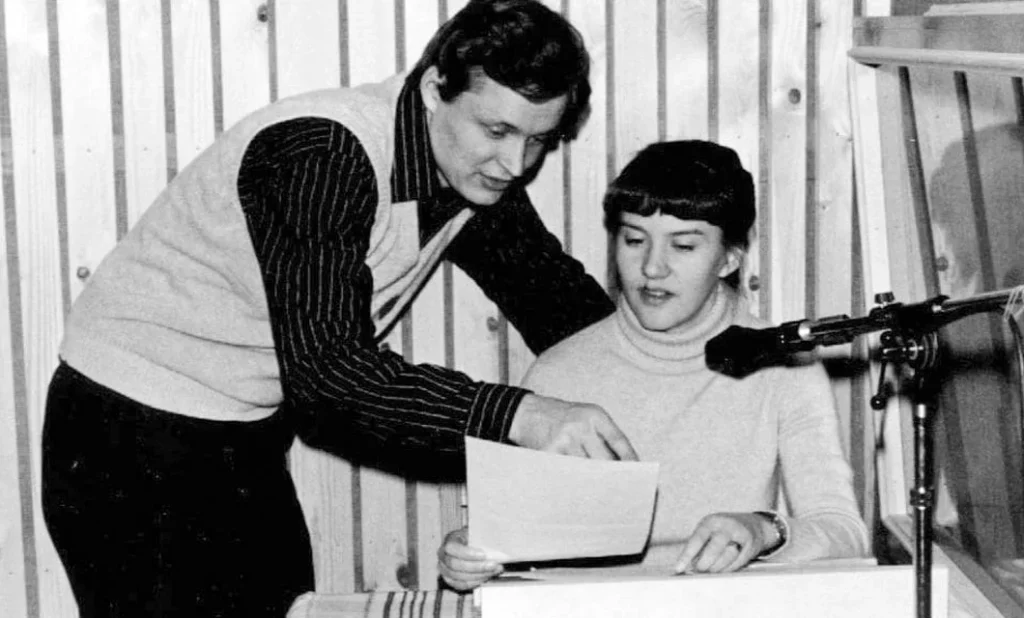
In a small village in Finland, Hannu and Laura Haukka turned one of the bedrooms of their two-bedroom home into a radio studio.
With the support of faithful partners like you, they began producing Russian-language Christian programming for listeners inside the Soviet Union.
On September 5, 1981, their first Russian-language programme went on the air.
At 8:45 p.m. Moscow time, the broadcast was transmitted from Lisbon, Portugal. Hannu stood outside in Helsinki with a small shortwave radio and listened as the programme travelled across Europe toward the Soviet Union.
There was no way to know who was listening on the other side.
But people were.
For Christians living behind the Iron Curtain, shortwave radio had become much more than another form of communication.
It was a lifeline.
Through the interference came Scripture, Christian teaching, prayer and the message that God had not forgotten them.
Years later, after the Iron Curtain fell, stories began reaching the ministry about what those broadcasts had meant. Individuals and families had found faith through the programmes. In one extraordinary account recorded in Only Believe!, an entire village in southern Russia had come to Christ through the radio broadcasts.
The technology changes. The calling does not.
More than four decades have passed since that first Russian-language programme.
The barriers look different today.
In many parts of the world, internet access is filtered, television signals are restricted, Christian content is censored, and openly exploring faith in Jesus can carry significant personal risk.
And still, people search.
They find satellite broadcasts. They use digital platforms and VPNs. They watch programmes privately on phones. They ask questions online that they may not feel free to ask publicly.
The technology available to the Church has expanded in ways the early radio pioneers could scarcely have imagined.
Radio. Satellite television. Streaming. Social media. Digital campaigns. Smartphones.
GCMM continues to use these tools to bring the message of Jesus Christ into some of the world’s hardest-to-reach regions.
The medium is never the message. But the medium can carry the message across a border.
A radio signal can enter a home.
A satellite broadcast can reach beyond censorship.
A video can appear on the phone of someone searching for answers late at night.
A digital campaign can introduce someone to the Gospel in their own language and connect them with believers who can answer their questions and walk with them.
An extraordinary time for the Great Commission
There is something deeply significant about Laura’s story.
Someone chose to broadcast the Gospel without knowing that a young girl in the Soviet Union would be listening.
That young listener would one day help send the same message back across the Iron Curtain.
And what began with shortwave radio would become part of a much wider media ministry reaching across nations and generations.
Today, the tools in our hands are more powerful than ever.
So is the responsibility.
Somewhere today, someone is searching.
They may not know a Christian. They may never have entered a church. They may live in a place where the Gospel is difficult to access.
But they may have a screen.
A signal.
A question.
And an open heart.
What an extraordinary time to be entrusted with the Great Commission.
The tools have changed.
The calling has not.
People are searching for the Good News.
Together, let’s help bring it to them.